Article
Test multi-agent AI systems with a five-layer testing framework
Learn how to evaluate agentic AI workflows for safety, reasoning, collaboration, observability, resilience, and production readinessTesting multi-agent AI systems requires more than checking whether an AI model returns the correct answer. Autonomous AI systems can reason, plan, use memory, call tools, collaborate with other agents, and run workflows with limited human intervention. In a multi-agent workflow, one agent can produce a correct result while the overall workflow fails because of an incorrect handoff, lost context, incorrect data transformation, coordination failure, or inappropriate escalation.
This article explains a lifecycle-based framework for testing agentic AI systems, with a focus on system-level and multi-agent behavior. The framework organizes testing into five layers: Foundation, Cognitive, Execution, Visibility, and Operational. An AI-driven loan approval scenario demonstrates how specialized AI agents collaborate across a business workflow.
Use the five-layer framework to test safety, reasoning, execution, agent collaboration, observability, and production readiness across an autonomous multi-agent workflow.
Why multi-agent AI systems require a different testing approach
Traditional software testing often uses predefined inputs, processing rules, and expected outputs. Generative AI introduces additional testing concerns, such as hallucinations, prompt injection, bias, grounding, and output variability.
Agentic AI systems add more complexity. An AI agent can decide what to do next, retrieve information, maintain context, select tools, perform actions, and adapt based on intermediate results. A multi-agent AI system adds another layer because multiple agents exchange information and coordinate tasks.
These capabilities change how teams test AI systems. For a traditional application, you might ask:
Does the system produce the expected result for this input?
For a multi-agent workflow, you must also ask:
- Did each agent receive the required information?
- Did the workflow preserve context during agent handoffs?
- Did each agent stay within its assigned role?
- Did the workflow transform information correctly between agents?
- Did the agents coordinate as expected?
- How did the agents handle conflicting recommendations?
- Did the workflow trigger human review when required?
- Can you trace the final decision to the evidence and agent interactions that produced it?
- Does the workflow remain reliable when dependencies fail or workload increases?
These questions show why testing each agent independently is not enough. Individual agents can work correctly in isolation while the overall multi-agent system fails because of incorrect interactions between agents.
The testing framework therefore evaluates the autonomous multi-agent system across the full lifecycle instead of treating the system as a collection of isolated AI model calls.
From agent-level validation to system-level assurance
Multi-agent AI testing should cover three levels: individual agents, agent interactions, and the complete system.
| Testing level | Primary question | Examples |
|---|---|---|
| Agent level | Does an individual agent behave correctly? | Prompt handling, reasoning, memory retrieval, tool selection |
| Interaction level | Do agents and other components interact correctly? | Agent handoffs, communication, data validation, role boundaries |
| System level | Does the complete workflow achieve its objective safely and reliably? | End-to-end decisions, governance, observability, resilience |
These three testing levels work together.
For example, a risk assessment agent might calculate a risk score correctly, and a governance agent might apply a policy correctly. However, the overall system can still fail if the workflow transforms the risk score incorrectly when passing the score between agents.
The testing approach must therefore validate both individual agent behavior and overall system behavior.
How to test an agentic AI system
The five testing layers define what to test. The testing process defines how to validate each layer. Test controlled scenarios at the agent, interaction, and system levels, and collect evidence from each important step.
A typical testing process includes the following steps:
- Define the scenario and expected behavior. Identify the business objective, participating agents, expected decisions, policies, and escalation conditions.
- Prepare controlled inputs. Include standard, boundary, invalid, adversarial, and conflicting inputs as needed.
- Run the workflow. Run an individual agent or the complete multi-agent workflow under controlled conditions.
- Capture execution evidence. Record prompts, responses, memory access, tool calls, agent handoffs, payloads, decisions, confidence scores, and human interventions.
- Validate the behavior. Compare the agent and workflow behavior with the expected results. Check safety, correctness, data integrity, reasoning, policy compliance, workflow behavior, and final outcomes.
- Measure and classify failures. Use quantitative metrics where possible. Classify each failure by testing dimension and severity.
- Repeat the tests with different conditions. Run the scenarios again with different inputs, user attributes, conflicting evidence, dependency failures, and adversarial conditions. Repeated testing helps identify patterns that a single test might not reveal.
For example, when testing a handoff from Agent A to Agent B, do not test only whether each agent works correctly. Capture the output from Agent A and validate the output against the input schema for Agent B. Check that all required fields are present, verify that the workflow transforms the data correctly, and confirm that Agent B uses the expected values in the downstream decision.
This testing process makes the five-layer framework practical without depending on a specific AI model, orchestration platform, vendor, or evaluation tool.
Five-layer framework for testing agentic AI systems
The framework organizes agentic AI testing into five connected layers. Each layer focuses on a core question and a set of testing dimensions.
| Layer | Core question | Testing dimensions |
|---|---|---|
| Foundation | Can the AI system be trusted? | Prompt injection, guardrails, hallucinations, bias and fairness, uncertainty and confidence, non-deterministic outputs |
| Cognitive | Can AI agents reason and use context correctly? | Memory, decision intelligence, reasoning |
| Execution | Can AI agents act and collaborate responsibly? | Governance, human review, workflows, multi-agent testing |
| Visibility | Can teams understand and reconstruct system behavior? | Observability, traceability, auditability, decision evidence |
| Operational | Can the AI system operate reliably in production? | Performance, scalability, resilience, cost efficiency |
The five layers do not replace governance, security, or operational standards. The framework provides a testing structure that brings different quality concerns together across the agentic AI lifecycle.
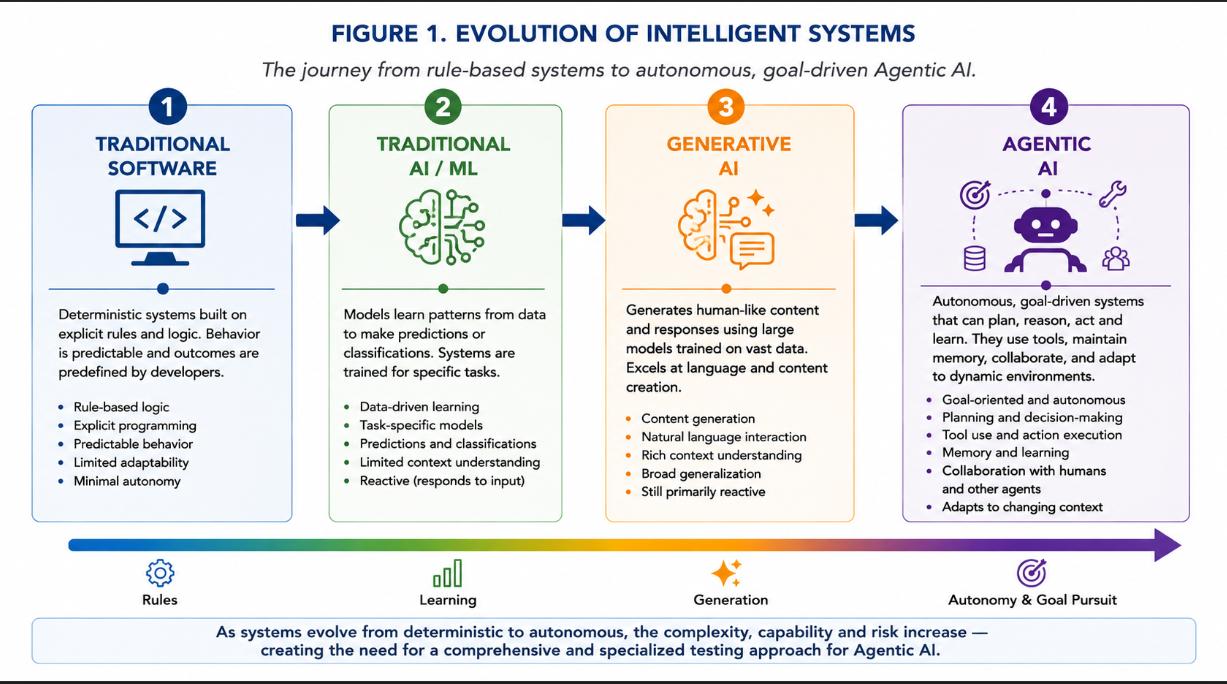
The progression in the diagram helps teams plan testing as AI systems become more autonomous. Testing expands beyond functional correctness to include safety, reasoning quality, execution integrity, transparency, governance, and production readiness.

Test the foundation layer for safety and reliability
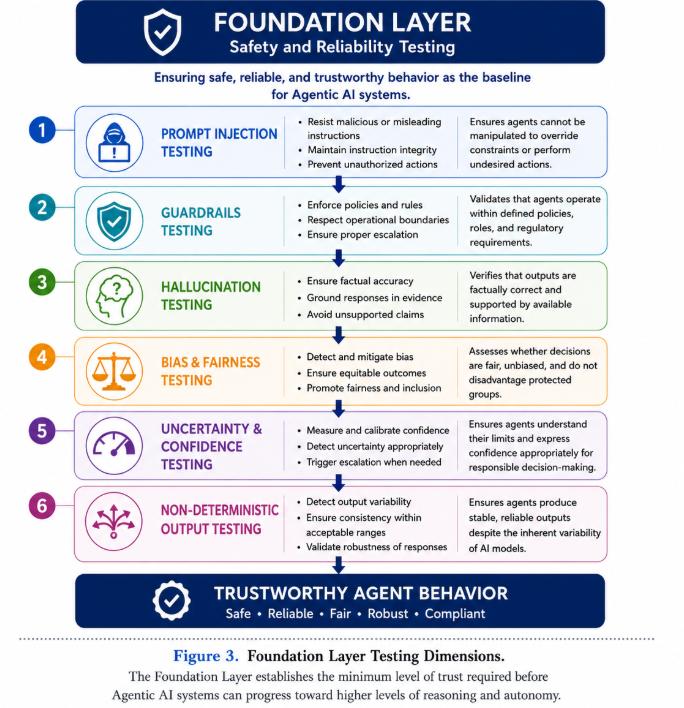
The Foundation layer tests whether an agentic AI system meets basic safety and reliability requirements before the system receives more responsibility.
Test prompt injection: Prompt injection testing checks whether AI agents resist malicious, misleading, or unintended instructions that attempt to change agent behavior.
For a multi-agent workflow, test both direct and indirect attacks, including:
- Direct attempts to override instructions
- Attempts to change an agent's assigned role
- Multi-turn attempts to manipulate context
- Malicious instructions in retrieved content
- Encoded or hidden instructions
- Attempts to trigger unauthorized actions
Testing should also verify whether a malicious instruction can move between agents. An agent might reject an attack, but the attack could still affect another agent later in the workflow.
Test guardrails: Guardrail testing checks whether AI agents follow defined policies, authorization boundaries, escalation rules, and regulatory requirements.
Test scenarios can include:
- Attempts to violate policies
- Boundary conditions
- Access control
- Escalation paths
- Attempts to perform restricted actions
In a multi-agent system, test guardrails at each relevant trust boundary. A downstream agent should validate instructions from another agent instead of automatically trusting the instructions because they came from within the system.
Test hallucinations: Hallucination testing checks whether an AI agent generates accurate information that is supported by available evidence.
Test scenarios can include:
- Missing information
- Contradictory information
- Evidence verification
- Repeated evaluations
- Assumption and fact checks
In a multi-agent system, test the complete chain of evidence. If Agent A generates an unsupported statement and Agent B treats the statement as a fact, the failure affects the entire multi-agent system, not only Agent A.
Test bias and fairness: Bias and fairness testing checks whether AI agent recommendations unfairly disadvantage individuals or groups based on irrelevant or protected characteristics.
Testing approaches can include:
- Paired profile comparisons
- Counterfactual testing
- Demographic analysis
- Fairness assessment over time
In a multi-agent workflow, test fairness in both intermediate recommendations and final outcomes. An unfair intermediate recommendation can influence decisions made by downstream agents.
Test uncertainty and confidence: Uncertainty and confidence testing checks whether AI agents recognize ambiguity and communicate uncertainty correctly.
Test whether the multi-agent system:
- Provides meaningful confidence estimates
- Maintains appropriate confidence levels
- Escalates uncertain cases when required
- Aligns confidence with observed performance
Also, test how the workflow passes confidence information between agents. A downstream agent should not treat an uncertain recommendation from another agent as a confirmed fact.
Test non-deterministic outputs: LLM-based agents can produce different outputs for the same input. Testing should determine whether this variation remains within acceptable limits rather than requiring identical outputs.
Testing approaches can include:
- Repeated executions
- Majority consensus evaluation
- Semantic similarity assessment
- Policy compliance checks across multiple runs
- Decision stability analysis
For high-impact workflows, verify that different valid responses still produce consistent business outcomes.
Test the cognitive layer for memory, reasoning, and decisions
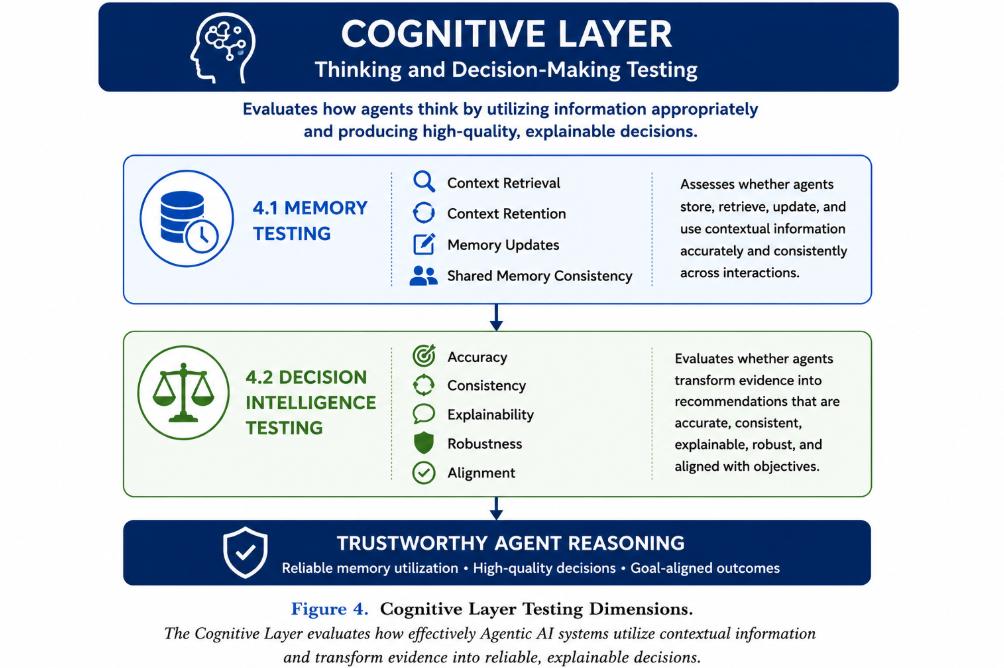
The cognitive layer tests whether AI agents use information correctly to reason and make decisions before taking action.
Test memory: Memory testing checks whether AI agents store, retrieve, update, and use context correctly.
Test the following areas:
- Context retention
- Retrieval accuracy
- Memory updates
- Outdated or irrelevant memory
- Cross-session continuity
- Shared-memory consistency
Memory is especially important in multi-agent systems because one agent can create context that another agent uses.
For example:
- Agent A identifies an important customer constraint.
- Agent A stores the constraint in shared memory or passes the constraint to the shared context.
- Agent B retrieves the constraint.
- Agent B uses the constraint to create a recommendation.
- Agent C uses the recommendation to perform an action.
An error at any step can change the final outcome, even when each agent works correctly on its own.
Test decision intelligence and reasoning: Decision intelligence and reasoning testing checks whether AI agents use evidence to produce accurate, consistent, explainable, and reliable recommendations that support the business objective.
Testing approaches can include:
- Ground-truth comparisons
- Repeatability assessments
- Explainability evaluation
- Sensitivity analysis
- Scenario-based robustness testing
When multiple agents contribute to a decision, test the complete decision chain. Verify that evidence supports the final recommendation and that each intermediate decision remains aligned with the business objective.
Test the execution layer for actions, workflows, and collaboration
The Execution layer tests how AI agents turn decisions into actions and collaborate across a multi-agent workflow.
Test governance: Governance testing checks whether AI agents follow:
- Organizational policies
- Business rules
- Authorization boundaries
- Required approvals
- Regulatory requirements
- Audit requirements
In a multi-agent workflow, test whether all agents follow the same policies. A downstream agent should not bypass a policy that an earlier agent enforced.
Test human review: Human-in-the-loop testing checks whether the multi-agent system involves a human reviewer when uncertainty, risk, or exceptions require human intervention.
Test the following areas:
- Escalation thresholds
- Handoffs to human reviewers
- Context provided to human reviewers
- Human overrides
- Propagation of human decisions
- End-to-end human interactions
For example, create a low-confidence or high-risk scenario and verify that the multi-agent system escalates the case to a human reviewer. Confirm that the workflow provides the required evidence, records the human decision, and continues correctly after the review.
Test workflows: Workflow testing checks whether the multi-agent system handles workflow steps, dependencies, branches, retries, exceptions, and completion conditions correctly.
Test scenarios can include:
- Expected workflow execution
- Dependency failures
- Parallel execution
- Retry behavior
- Exception handling
- Incomplete workflow states
- Premature workflow completion
For an autonomous system, testing should validate both the final result and the workflow that produced the result. The workflow path can affect safety, compliance, cost, and auditability.
Test multi-agent collaboration: Multi-agent testing checks whether AI agents work together correctly to achieve a shared objective.
Test the following areas:
- Accurate information exchange
- Context preservation during agent handoffs
- Agent coordination
- Agent role boundaries
- Conflict resolution
- Shared-state consistency
Use the following techniques to test agent collaboration:
Testing technique What to validate Communication pathway validation Messages reach the correct agent and contain the required information. Handoff testing Required context is preserved when information moves between agents. Coordination testing Agents perform tasks in the correct sequence and follow workflow dependencies. Conflict testing The multi-agent system detects conflicting recommendations and resolves conflicts according to policy. Role verification Each agent performs only the tasks assigned to its role. 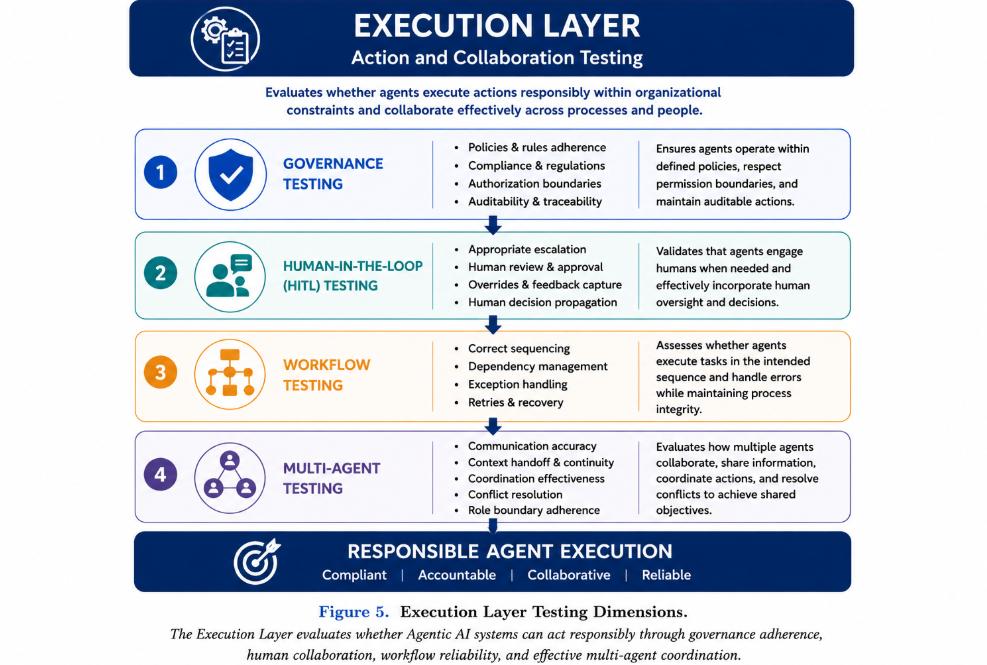
Test agent-to-agent data exchange
Agent-to-agent data testing checks whether data remains accurate and complete as the data moves between agents.
Consider the following payload from one agent:
{
  "customerId": "123",
  "salary": 85000,
  "riskScore": 0.72
}
A downstream agent might also require an employmentType field. Both agents can work correctly on their own, but the workflow can still fail if the data contract between the agents is incomplete.
Test agent-to-agent data exchange for:
- Schema validity
- Required fields
- Data types
- Field mappings
- Data transformations
- Payload integrity
- Business rules
- Contract compatibility
Also, test whether data keeps the correct business meaning during transformations. For example, if the salary value changes from 85000 to 8500, the payload might still pass schema validation even though the salary value is incorrect.
For this reason, schema validation alone is not enough. Multi-agent testing must validate both the structure and meaning of the data exchanged between agents.
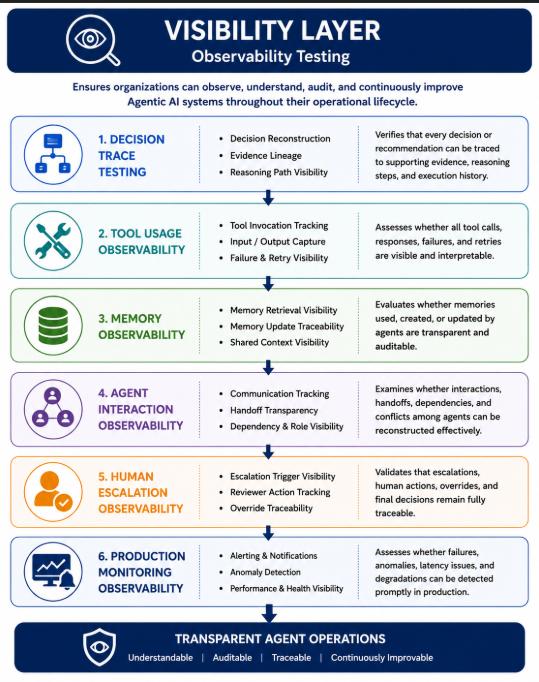
Test the visibility layer for observability and traceability
The Visibility layer tests whether teams can understand and reconstruct AI agent behavior. Without clear execution records, teams can have difficulty troubleshooting autonomous systems and explaining decisions.
Test whether the multi-agent system captures:
- Execution traces
- Agent interactions
- Tool calls
- Memory access
- Decision evidence
- Confidence values
- Human interventions
- Timestamps
- Workflow state changes
- Audit records
To test observability, start with a known outcome and verify that an engineer or auditor can reconstruct the workflow that produced the outcome.
For a multi-agent workflow, verify that the execution trace answers these questions:
- Which agent acted first?
- What information did the agent receive?
- What information did the agent produce?
- Which agent used that information next?
- Which tools or data sources did the agents use?
- Which agent produced the final recommendation?
- Did a human reviewer participate in the workflow?
- What evidence supported the final action?
Test the operational layer for production readiness
The Operational layer tests whether an agentic AI system can run reliably, scale with demand, recover from failures, and manage costs in production.
Test performance:
Measure:
- Response time
- 95th percentile (P95) and 99th percentile (P99) latency
- Throughput
- Workflow completion time
Multi-agent workflows can add latency. Each reasoning step, tool call, memory operation, and agent handoff increases the total processing time.
Test scalability: Test the agentic AI system under:
- Increasing request volumes
- Concurrent users
- Concurrent workflows
- Peak demand
- Increased agent activity
As the workload increases, monitor throughput, latency, resource usage, and performance degradation.
Test resilience: Agentic AI workflows can depend on AI models, APIs, databases, memory stores, tools, and other services. Test how the workflow handles:
- Unavailable services
- Network failures
- Tool failures
- Memory store failures
- Agent timeouts
- Partial workflow failures
Verify that the multi-agent system handles failures without disrupting the entire workflow. Test recovery, failover, and prevention of cascading failures.
Test cost efficiency:
Measure:
- AI model calls
- Token usage
- Tool calls
- Memory operations
- Compute usage
- Cost per transaction
An agentic AI system might produce the correct result but still be too expensive to operate. Cost-efficiency testing helps identify unnecessary model calls, tool calls, and other resource usage.
Apply the five-layer framework to a loan approval workflow
An AI-driven loan approval workflow shows how the five-layer framework can test a multi-agent system. The workflow combines autonomous decisions, multiple agents, governance controls, uncertainty, and human review.
The workflow can include specialized agents for application validation, customer verification, fraud detection, risk assessment, governance, confidence assessment, and final decisions. The workflow can approve an application, reject an application, or escalate an application for human review.
Apply the five testing layers as follows:
| Layer | Example validation |
|---|---|
| Foundation | Test prompt injection, guardrails, hallucinations, bias, and uncertainty. |
| Cognitive | Test memory retrieval, decision consistency, and reasoning quality. |
| Execution | Test workflow sequencing, agent handoffs, governance, human review, and agent-to-agent data exchange. |
| Visibility | Verify that teams can trace decisions, evidence, agent interactions, and human interventions. |
| Operational | Test latency, throughput, resilience, scalability, and cost efficiency. |
Testing should not stop at the final loan decision. Test the complete workflow, including the input, agent decisions, handoffs, governance controls, human review, and final outcome.
For example:
- Use a high-risk loan application to test risk assessment and governance controls.
- Use an adversarial instruction to test prompt injection protection.
- Use an application that exceeds an uncertainty or policy threshold to test human escalation.
- Use a malformed payload between two agents to test data integrity and contract compliance.
The five-layer framework turns multi-agent AI testing into a structured set of test objectives across the complete loan approval workflow.
Test human escalation and decision evidence
A multi-agent system should involve a human reviewer when the workflow reaches a defined limit for autonomous decision-making.
For example, configure a loan application to trigger an uncertainty or governance threshold. Verify the complete escalation process:
- The multi-agent system detects the condition.
- The workflow applies the escalation threshold correctly.
- The workflow sends the loan application to a human reviewer.
- The human reviewer receives the required context and evidence.
- The workflow records the human reviewer's decision.
- The workflow passes the human decision to the appropriate agents.
- The final loan decision reflects the human decision.
- The system records the complete interaction for tracing and auditing.

Also, verify that the system records the evidence behind each decision. A tester should be able to review the recommendation, supporting evidence, and confidence information instead of seeing only the final loan decision.

Test confidence and explainability together. Verify that the confidence value reflects the available evidence and that the explanation supports the agent's recommendation.

Capture evidence for multi-agent execution
Observability should capture enough information to trace agent interactions and investigate failures in a multi-agent workflow.
Capture the following information:
- Agent-to-agent interactions
- Execution timestamps
- Workflow progress
- Decision history
- Evidence used by each agent
- Human interventions

Execution evidence supports both testing and production monitoring. If the multi-agent system produces an incorrect decision, the execution trace can help identify whether the failure came from input data, agent reasoning, memory retrieval, an agent handoff, a tool call, a policy violation, or a data transformation.
Use metrics to evaluate the testing framework
The testing framework defines what to test without depending on specific tools or technologies. Select metrics based on the testing objective, business risk, and potential impact of a failure.
| Testing area | Example metrics |
|---|---|
| Prompt injection | Injection resistance rate, policy compliance rate, unauthorized action frequency |
| Guardrails | Guardrail adherence rate, policy violation frequency, escalation accuracy |
| Hallucination | Hallucination frequency, evidence alignment score, consistency rate |
| Bias and fairness | Demographic parity, equal opportunity difference, calibration consistency |
| Uncertainty | Expected calibration error, escalation accuracy, confidence and outcome alignment |
| Memory | Retrieval accuracy, context retention rate, shared-memory synchronization, memory consistency |
| Decision intelligence | Decision accuracy, recommendation consistency, robustness, objective alignment |
| Multi-agent collaboration | Handoff success rate, communication accuracy, coordination effectiveness, conflict resolution rate |
| Observability | Trace completeness, decision traceability, audit evidence completeness |
| Performance | Average response time, P95 and P99 latency, throughput |
| Resilience | Recovery success rate, mean time to recovery (MTTR), failure containment rate |
| Cost efficiency | Cost per transaction, token usage, tool invocation cost |
These metrics do not define universal acceptance thresholds. Each organization should set thresholds based on the business process, level of risk, regulatory requirements, and potential impact of a failure.
Keep the testing framework tool-agnostic
The testing framework does not depend on a specific tool or platform. Testing tools can support evaluation, tracing, monitoring, automation, and performance testing, but the tools should not define the testing strategy.
Testing tool categories can include:
- Prompt injection and adversarial testing tools
- Guardrail evaluation frameworks
- LLM evaluation frameworks
- Retrieval-augmented generation (RAG) evaluation tools
- Observability and tracing platforms
- Workflow testing environments
- Performance testing tools
- Resilience and fault-injection tools
Define the testing objective first, and then select the appropriate tools and implementation methods.
This approach keeps the testing framework relevant as AI models, platforms, and testing tools change.
Integrate agentic AI testing throughout the lifecycle
Agentic AI testing should continue throughout the development lifecycle, from requirements analysis to production monitoring.
During requirements analysis
Identify:
- High-impact decisions
- Acceptable risk thresholds
- Conditions that require human review
- Critical data exchanges between agents
- Evidence required to support decisions
During architecture and design
Define:
- Observability requirements
- Trace collection requirements
- Confidence reporting
- Agent-to-agent contracts
- Human escalation mechanisms
- Data validation points
During development and testing
Combine traditional software testing with:
- Adversarial testing
- Repeated execution
- Workflow validation
- Multi-agent interaction testing
- Human-in-the-loop testing
- Memory validation
- Data contract testing
After deployment
Continuously monitor the agentic AI system for:
- Changes in agent behavior
- Changes in decision patterns
- New failure modes
- Changes in human escalations
- Performance degradation
- Cost increases
This approach makes agentic AI testing a continuous process that validates system safety, reliability, and performance throughout the AI system lifecycle.
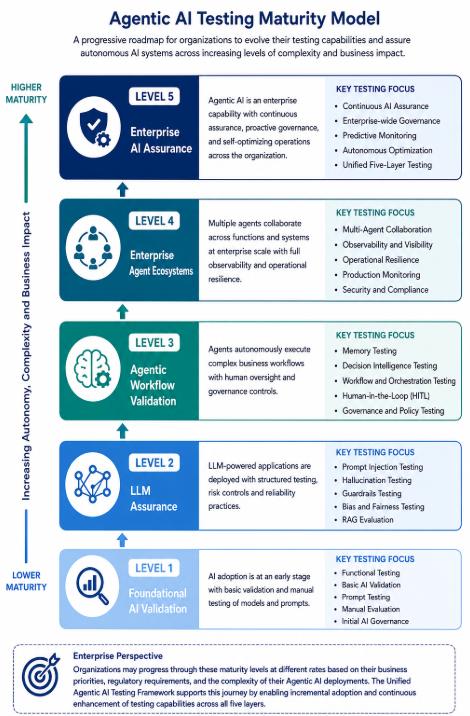
Build an agentic AI testing maturity path
Organizations do not need to adopt every agentic AI testing capability at the same time. The five-level maturity model provides a practical path for expanding testing as AI systems become more autonomous and complex.
| Level | Organizational state | Primary testing focus |
|---|---|---|
| 1. Foundational AI validation | Individual AI models or basic chatbots | Prompt validation, hallucinations, guardrails, bias and fairness |
| 2. LLM assurance | LLM applications with increased governance requirements | Foundation testing, RAG evaluation, explainability, uncertainty |
| 3. Agentic workflow validation | Autonomous AI agents run workflows with human oversight | Memory, reasoning, workflows, human review, governance |
| 4. Enterprise agent ecosystems | Multiple AI agents collaborate across business processes | Multi-agent testing, observability, security, resilience |
| 5. Autonomous enterprise assurance | Agentic AI operates as an enterprise capability | Testing across all five layers with continuous evaluation |
The maturity model provides a roadmap, not a compliance requirement. Organizations can adopt testing capabilities from different maturity levels based on business priorities and risk.
Expand quality engineering for agentic AI systems
Agentic AI testing expands quality engineering from testing individual outputs to testing behavior across the complete AI system lifecycle.
A trustworthy multi-agent system should provide evidence that the system can:
- Resist unsafe and adversarial inputs.
- Use data, context, and memory correctly.
- Reason and make decisions consistently.
- Exchange information accurately between agents.
- Follow agent roles and authorization boundaries.
- Escalate high-risk or uncertain decisions to human reviewers.
- Run workflows reliably.
- Provide observable and auditable execution records.
- Recover from failures.
- Meet performance and cost requirements.
Agentic AI testing also requires collaboration across teams. Business stakeholders, product teams, AI engineers, software engineers, quality engineers, risk and compliance teams, human reviewers, and operations teams each contribute to testing and validating the multi-agent system.
Understand the framework limitations and next steps
The five-layer framework provides a structure for testing agentic AI systems. The framework does not require specific tools, datasets, benchmarks, metrics, or development processes. Organizations should adapt the framework to their business domain, system architecture, regulatory requirements, and governance practices.
The AI-driven loan approval example shows how teams can apply the framework in a controlled environment. The example is not a production benchmark. Testing the framework across other business domains and larger datasets can provide additional validation.
A practical next step is to build reusable testing harnesses that combine:
- Test scenarios
- Evaluation methods
- Evidence collection
- Testing metrics
- Reporting
- Quality gates
- Automated test execution
- Continuous integration and continuous deployment (CI/CD)
Reusable testing harnesses can help teams move from defining what to test to implementing and automating how to test agentic AI systems.
Summary
Multi-agent AI systems require more than testing individual AI agents and their outputs. Testing must also cover agent reasoning, memory, tool calls, agent interactions, workflows, human review, and production dependencies.
The five-layer framework organizes these testing requirements:
- Foundation: Tests safety and reliability.
- Cognitive: Tests memory, reasoning, and decision-making.
- Execution: Tests governance, human review, workflows, and multi-agent collaboration.
- Visibility: Tests observability and traceability across the workflow.
- Operational: Tests production readiness, resilience, scalability, performance, and cost efficiency.
The key principle is simple: test each AI agent, the interactions between agents, and the complete multi-agent workflow.
Next steps
Start with one representative multi-agent business workflow. Map the AI agents, agent handoffs, decisions, tools, memory, human review points, and operational dependencies to the five testing layers.
Use the workflow map to define test scenarios and evidence requirements. After defining the testing requirements, select the appropriate automation and evaluation tools.