Article
All the Ops: DevOps, DataOps, MLOps, and AIOps
Defining the Ops and how they fit togetherIn recent years, there has been a rapid increase in acronyms with the “Ops” suffix, which initially started by the merging of development and IT operations (DevOps). This pairing together of disciplines helped enterprises better define their processes, improve the quality of their output, and operate at much faster speed.
In this article, I’ll define the most common Ops – DevOps, DataOps, MLOps, and AIOps – and how they work together. Watch the following video for a summary of these definitions, and then read on for more details.
Defining all the Ops
Let’s start by defining DevOps, the one that started it all. DevOps is a set of practices that combines software development (Dev) and information technology operations (Ops) that aims to shorten the development lifecycle and provide continuous delivery with high software quality. Because security is a shared responsibility integrated from end to end, DevSecOps was defined and emphasizes the need to build a security foundation into DevOps initiatives. You can learn more about DevOps and DevSecOps by exploring the DevOps content on IBM Developer.
As DevOps improved the quality and scalability of software development, the data analytics discipline sought to bring these same improvements to their practices. Thus, DataOps was defined. In a nutshell, DataOps applies agile development, DevOps, and lean manufacturing to data analytics (Data) and operations (Ops). Read more about DataOps in this introduction to the DataOps discipline.
Here is where machine learning enters the picture, since machine learning models leverage large sets of data. MLOps is meant to standardize and streamline the lifecycle of machine learning models in production by orchestrating the movement of machine learning models, data, and outcomes among the systems.
And now that brings us to AIOps, or artificial intelligence (AI) for IT operations. AIOps replaces many tedious, manual IT operations with an intelligent IT operations platform that collects structured and unstructured data, identifies events and patterns, reduces noise, and reports or remediates issues, thus greatly enhancing the productivity of the team responsible for keeping operations up and running. You can learn more about AIOps by exploring the AIOps content on IBM Developer.
Finally, ChatOps is the use of chat clients, chatbots, and real-time communication tools to facilitate how software development and operation tasks are communicated and executed. This can be used in combination with any of the other Ops above.
How all the Ops work together
Now that we understand the basic definitions of all the Ops, let’s look at how all these Ops – DevOps, DataOps, MLOps, and AIOps – work together.
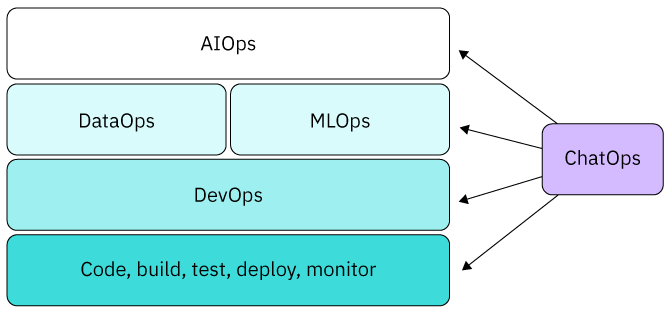
First, we must start with what developers do when developing an application. Typically, you first code the app, then test it by writing some unit tests and integration tests, followed by deployment, and finally you monitor it to see if there are any issues. Whether using waterfall or agile, the overall steps are the same, just iterated more frequently. Over the years, this has become DevOps by adding automation to the coding, building CI/CD pipelines to automatically build the app and run the tests when a pull request is created. DevOps practices traditionally apply to the end-to-end lifecycle of developing applications.
DataOps is simply applying DevOps to data instead of an application or traditional code. DataOps is managing the whole data lifecycle, from creation to deployment to monitoring that data. Similarly, MLOps applies DevOps principles but to machine learning models, which are like applications but requiring training, running interference, and verifying that the results are accurate. Both DataOps and MLOps are DevOps-driven.
AIOps includes DataOps and MLOps. Because AI needs to have data coming in, such as logs or metrics, and that data needs to be managed in terms of the lifecycle to check the accuracy and right stats, AIOps uses DataOps. Because AI is driven by machine learning models and it needs machine learning models to be created, deployed, trained, and analyzed to see if the results are accurate, AIOps includes MLOps as well. DevOps is used in AIOps for lifecycle management and automation of all the applications that comprise the AIOps. And, finally, AIOps can be used to further optimize and make better decisions along the software development lifecycle of DataOps, MLOps and DevOps. In summary, AIOps uses these Ops, and AIOps can also be applied inside each of these Ops.
Applying AIOps
Enterprises are turning to AI-powered automation to ensure faster decision-making, better resource optimization, and proactive resolution. One major area for this is in the IT operations space. So, how do you put AIOps to work for your enterprise?
A good AIOps implementation requires three layers:
- Observability -- First and foremost, your AIOps implementation needs to observe, which requires good observability monitoring and data, in the form of metrics, logs, events, and incidents that are happening in real time. Network monitoring is an example that will help you understand any performance issues.
- Resource optimization -- The more data you have, the better you’ll understand the topology or resource graph or the grouping. With the topology, you can optimize the usage of resources to help avoid problems altogether or remediate problems quickly. For example, if you have two VMs that don't have enough traffic, then the two VMs could be optimized to just one VM for doing cost optimization in that cloud vendor.
- Problem determination -- With what you learn from the results of observability and resource optimization, you can proactively anticipate problems and automate fixes to problems.
When an AIOps solution is first deployed in an enterprise, there is always a journey both in trust and in capabilities. As AIOps uses a variety of machine learning techniques, there is typically a training period where the AIOps solution is gathering baseline data, and then over time it continues to learn from the observed behavior and feedback.
At the same time, there is a lack of trust by the operations team warranting guard rails, and rightly so. One manifestation of this is to allow the AIOps solution to provide suggestions, but require supervision before implementation. Also, AIOps solutions must clearly explain any predictions it makes because AIOps should be transparent and not act like a black box. Over time, trust will increase and automation can be put in place, outages can be avoided, and an enterprise can reap the full rewards with increased productivity and decreased outages.
Summary and next steps
AIOps is an evolution of the development and IT operations disciplines. Because AIOps incorporates the fundamentals of DataOps and MLOps, which are both DevOps-driven practices, AIOps implementations help enterprises eliminate errors, streamline workflow processes, improve collaboration, and enhance transparency.
To learn more about IBM's AIOps solution, IBM Cloud Pak for Watson AIOps, read our article Improving and automating your ops.