Blog post
Introducing a developer's course on post-quantum cryptography
A dynamic approach to learning the basics of quantum-safe cryptography and the keys to applying the new cryptographic schemes with agilityTL;DR
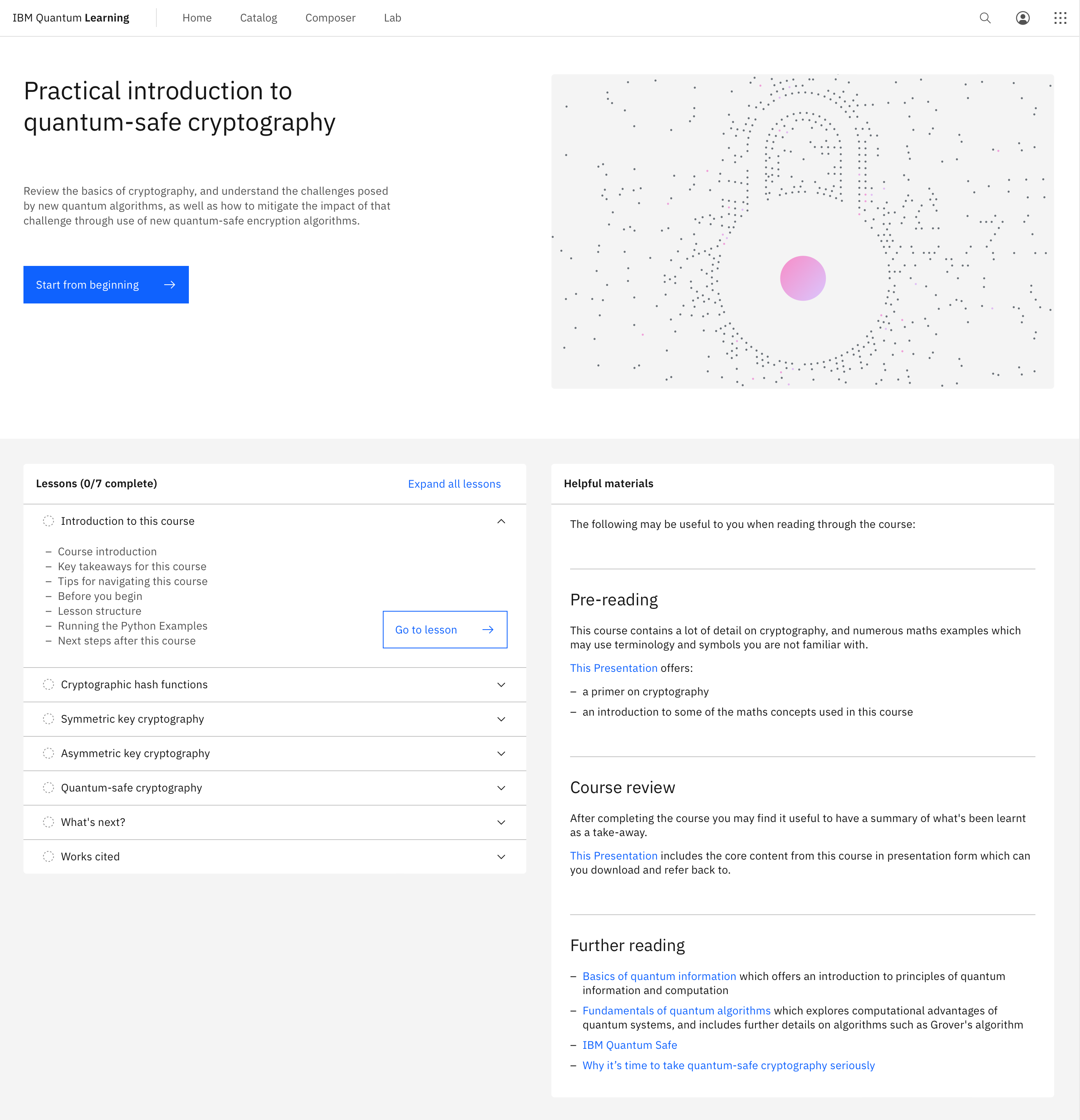
Practical introduction to quantum-safe cryptography is a free online course on the IBM Quantum Learning platform and serves as a primer on the foundational concepts in quantum-safe cryptography. This course was created for developers who are interested in modernizing their application security and features multimodal lessons and interactive live code examples in four core areas of cryptography: cryptographic hash functions, symmetric key cryptography, asymmetric key cryptography, and quantum-safe cryptography. By taking this course, developers will learn how the cybersecurity risk landscape is evolving in the quantum era and steps they can take today to mitigate at-risk cryptography within their applications.
Why learn quantum-safe cryptography?
Our modern digital world depends on cryptography as a critical line of defense. Cryptography secures our online banking applications, healthcare records, e-commerce transactions, and electronic messaging systems. All of our digital interactions with these systems are based on trust - trust that our interactions are secured. However, as quantum computing technology matures, we will have to develop new ways of safeguarding that trust and security.
How quantum computing changes the cybersecurity landscape
Mature quantum computers would be able to solve complex math problems more rapidly than classical computers. That means that most of today’s cryptography, which depends on the difficulty of math problems like discrete logarithm and prime factorization, will become obsolete as these devices advance in scale, quality, and speed. Two quantum algorithms in particular present challenges to the most widely used encryption algorithms:
- Shor’s algorithm, which computes the prime factors of large numbers
- Grover’s algorithm, which can quickly search unsorted lists
While the timeline for a cryptographically relevant quantum computer is unknown, cybercriminals might already be using “harvest now, decrypt later” attacks to steal and store data until they can decrypt it. Because sensitive data often must remain confidential for decades, the cybersecurity protocols we use today must safeguard our data now and in the future. To address this challenge, governments and regulatory bodies around the world have begun establishing guidelines for transitioning to “quantum-safe cryptography,” cryptographic algorithms and protocols that are better able to withstand classical and quantum cyberattacks.
Currently, organizations such as the National Institute of Standards and Technology (NIST) in the United States are directing formal standardization processes for the new quantum-safe algorithms. However, developers should not wait until the standards are published to build competency in quantum-safe cryptography. The ability to identify at-risk cryptography and mitigate it with quantum-safe alternatives will be key for managing the security of applications with agility.
A hands-on way to learn the next generation of cryptography
We created Practical introduction to quantum-safe cryptography as a free, hands-on primer course in quantum-safe encryption algorithms. With interactive lessons and labs, the course enables developers to cultivate a foundational understanding of cybersecurity in the quantum era and learn what they can do to prepare for the quantum-safe transition.
Course pedagogy
This course will be useful for anyone looking to learn the basics of quantum-safe cryptography, but it was created with developers who are responsible for enterprise cybersecurity in mind. These are security engineers and, more broadly, developers who are responsible for ensuring enterprise software and networks are secured and kept secured over time, particularly in response to the increasing quantum cybersecurity risks.
We designed the course with the goal of balancing the need for a complete, thorough, and semi-rigorous introduction to the field. This means including practical examples that developers can readily try and use.
Course overview
The course is divided into five modules, each of which features a combination of slides, text, and hands-on coding examples. Learners have the option to explore the mathematics underpinning the encryption algorithms or to save the math for future investigations if they are looking to understand the core concepts without the theoretical details. Downloadable slide resources serve as references for the lessons: one constitutes a “quick guide” for the core concepts, and another functions as an in-depth course summary for more detailed study. All learners will enjoy the inline Jupyter live code that illustrates the concepts. Using a free IBM Cloud account, learners can execute, modify, rerun, and analyze the code in small sections to strengthen their understanding of the cryptographic principles and implementations.
In future versions of the course, we will enable a short quiz at the end of each module. These quizzes will test the learner’s understanding of the content and strengthen their confidence in their ability to mitigate quantum vulnerabilities in source code.
To ensure we present a thorough overview of cryptography and highlight all the known quantum cybersecurity risks, the course covers four key areas in cybersecurity:
- Cryptographic hash functions
- Symmetric key cryptography
- Asymmetric key cryptography
- Key exchange protocols
At the end of each module, we explain how quantum algorithms present challenges to the cryptographic primitives discussed.
The final module surveys the leading quantum-safe cryptography efforts. This includes discussions of Shor’s and Grover’s algorithms, the NIST Post-Quantum Cryptography Standardization project, and the algorithms that have emerged from the multiyear competition. Finally, using inline coding examples and an optional deep dive into lattice theory, we show how the new quantum-safe Kyber algorithms work in hybrid implementations with traditional key exchange mechanisms (KEMs).
The course concludes with a series of next steps that provide developers with concrete actions they can take today to begin applying their knowledge and exploring quantum-safe technologies. For example, learners will encounter an overview of IBM Quantum Safe technology, a comprehensive set of tools, methods, and approaches to help organizations transition to quantum-safe cryptography.
Begin your quantum-safe learning journey today
Every enterprise developer needs to understand the ways in which quantum technology creates new cybersecurity demands and to build skills in quantum-safe cryptography. With its multimodal lessons and interactive coding examples, Practical introduction to quantum-safe cryptography offers a dynamic approach to learning the basics of quantum-safe cryptography and the keys to applying the new cryptographic schemes with agility. Establishing competency in quantum-safe cryptography now will equip developers not only to protect their applications from “harvest now, decrypt later” attacks, but also to address potential quantum cyberattacks in the future without disrupting business operations or expending resources unnecessarily.
Begin your quantum-safe learning path today and discover how proficiency in quantum-safe cryptography fundamentals enables you to enhance the security of your applications and establish crypto-agility in a rapidly evolving cybersecurity landscape.
Go beyond the basics
For those who want to go deeper in their study of the quantum algorithms touched on in this course, learners are encouraged to explore additional courses on the IBM Quantum Learning platform such as Basics of Quantum Information and Fundamentals of Quantum Algorithms. These courses explain in more detail the mathematics of quantum information and how Shor’s and Grover’s algorithms solve the problems of integer factorization and unstructured search, respectively.