Article
Watson Libraries: Embeddable AI that works for you
Easily access AI capabilities and choose a specific function, such as natural language processing, that you want to embed in different parts of your applicationWith Watson Libraries, IBM introduces a common library framework for natural language processing (NLP), speech, document understanding, translation, and trust. It's a framework that is specifically designed for developers to embed artificial intelligence (AI) into their products. IBM Watson Libraries is designed to help lower the barrier for AI adoption by helping address the skills shortage and development costs that are required to build AI models from scratch.
The three new libraries available are:
IBM Watson Natural Language Processing library: This library is designed to help you provide capabilities to process human language to derive meaning and context.
Watson Speech to Text (STT) Library for Embed: This library is designed to enable speech transcription with speed and accuracy to help businesses improve customer service experiences.
Watson Text to Speech (TTS) Library for Embed: This library is designed to enable you to convert written text into natural sounding audio with accuracy in various languages and voices.
The libraries include innovations that are developed by IBM Research as well as open source technology and are designed to reduce the time and resources that are required for a developer to add powerful AI to an application.
The Watson NLP library comes with hundreds of pretrained models in a vast assortment of global languages with dozens of modules for NLP tasks, including sentiment analysis, phrase extraction, and text classification. Using these models, you can save time and compute costs on training models and return the value of embedded AI faster.
The following image shows an overview of the Watson Libraries along with their current task capabilities.

The current release of the Watson NLP Libraries includes not only libraries but an entire self-starter assets collection that helps you quickly build natural language processing and speech solutions. The self-serving assets come with everything a data science team needs and are designed to guide you in every step of the process -- from designing the model to training, deploying, and automating it for production. The following image shows the entire process.
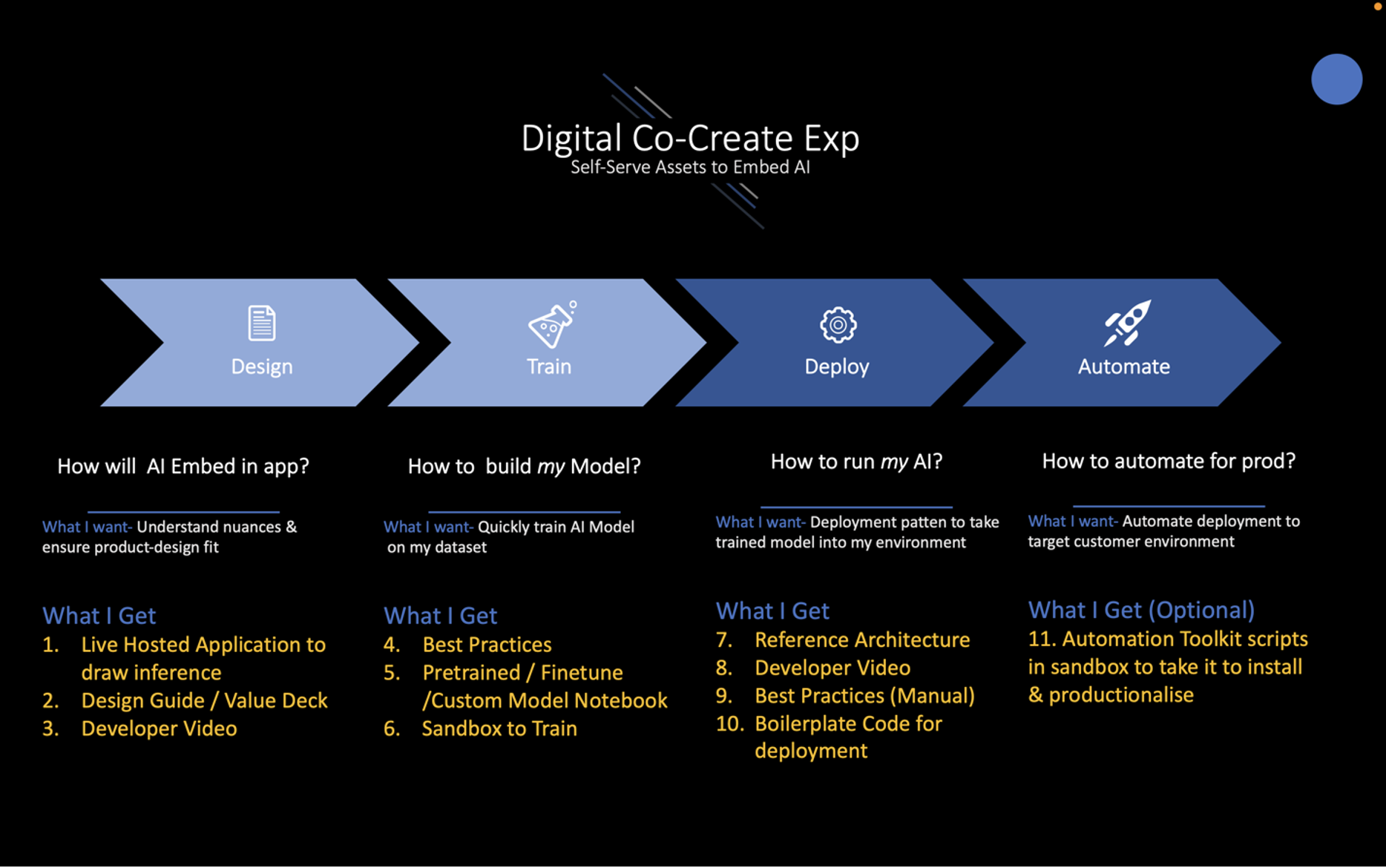
Data science self-serve assets
The data science self-serve assets provide design guides, developer videos, and notebooks for various AI use cases for a team to use to build their models. They also come with a reservable environment so that you can quickly try the models with your data sets and fine-tune them. The following image shows the current IBM Watson Libraries coverage.

The self-serve assets for Watson NLP Libraries currently have notebooks built for sentiment and emotion analysis for customer reviews, topic modeling for customer complaints, text classification for product complaints and feedback as well as keyword, phrase, and entity extraction. Watson NLP comes with wide support for global languages.
In terms of the Watson Speech Library, there are ready-to-deploy assets for speech-to-text that can even detect noise, number of speakers, and so on. There’s also assets for text-to-speech that can convert English text to speech in both male and female voices.
All of these functions come with a ready-to-use hosted AI application for you to try.
Approximately 50% of NLP tasks are released with the complete set of self-serve assets and notebooks, while the remaining 50% of NLP tasks are available for you to build your models on using library documentation.
MLOps self-serve assets
For MLOps engineers, Watson Libraries has a complete set of boilerplate codes along with reference architecture to help you easily deploy the models to run anywhere -- be it hyperscalers, in a single container, using Kubernetes services, or deploying using a Kserve Model mesh runtime. The following image shows the embeddable AI deployment coverage.

Taking machine learning models to production is one of the biggest bottlenecks in the AI lifecycle. MLOps assets provide quick-to-operationalize models on any infrastructure, saving you time and money. Additionally, for IBM Business Partners, there is an available Tech Zone automation accelerator toolkit that can take models to production in less than one hour. Currently, the automation toolkit is on an IBM Red Hat OpenShift Kubernetes Service (ROKS) cluster on IBM Cloud, but will expand soon to include all other hyperscalers like Amazon Web Services (AWS), Azure, and Google Cloud Platform.
Summary
This article explained how you can easily access AI capabilities and choose a specific function, such as natural language processing, that you want to embed in different parts of your application to make embeddable AI part of your solution.
You can start your AI journey by browsing and building AI models through a guided wizard.