Blog post
Introducing Docling for IBM watsonx
Transform enterprise documents into AI-ready structured data with IBM's managed document intelligence serviceTL;DR: Docling for IBM watsonx is a fully managed SaaS that converts enterprise documents (PDFs, slide decks, scanned contracts) into AI-ready structured data up to 14× faster than Docling OSS, with no infrastructure to manage.
Unstructured data represents roughly 90 percent of all enterprise information. However, most of that data is not directly usable by AI systems without significant preprocessing and context reconstruction. Enterprise knowledge is trapped in PDFs, slide decks, scanned contracts, technical manuals, and reports that were designed for people to read, not for AI systems to process. When that content is flattened into plain text, structure disappears, and without structure, even the best foundation models struggle to retrieve the right context and generate grounded responses.
Modern frontier models can understand individual documents remarkably well, making them an excellent choice for summarizing a report or answering questions about a single PDF. But enterprise AI rarely involves a single document. Organizations need to prepare thousands (or even millions) of documents for retrieval, search, AI agents, and automation. At that scale, repeatedly sending raw documents to frontier models becomes expensive, difficult to operationalize, and inefficient.
To solve this issue, IBM recently released Docling for IBM watsonx, a fully managed document intelligence service that converts complex, multi-format enterprise documents into AI-ready structured data while preserving the structural intelligence of a document, including the layouts, tables, reading order, document hierarchy, and metadata that large language models depend on for accurate retrieval and reasoning. Therefore, downstream retrieval-augmented generation (RAG) pipelines, enterprise search, and AI agents receive clean, trustworthy inputs that more accurately reflect the original source.
Benefits of Docling for IBM watsonx
Built on the open-source Docling toolkit (which has surpassed 70 million downloads), Docling for IBM watsonx combines the proven document understanding capabilities of Docling OSS with IBM-managed infrastructure, continuous model improvements, and cloud-native runtime optimizations.
Docling for IBM watsonx provides:
- Up to 14 times faster document processing than a standard Docling OSS deployment.
- Higher-quality AI-ready structured outputs compared to Docling OSS through enhanced document understanding models.
- A fully managed SaaS, which means you have no GPUs, workers, queues, scaling policies, or infrastructure to manage.
- 20% lower cost than the lowest-priced comparable managed offering (Azure Content Understanding).
Docling for IBM watsonx is a service that enables developers to build production-scale AI applications without worrying about document processing infrastructure.
Architecture of Docling for IBM watsonx
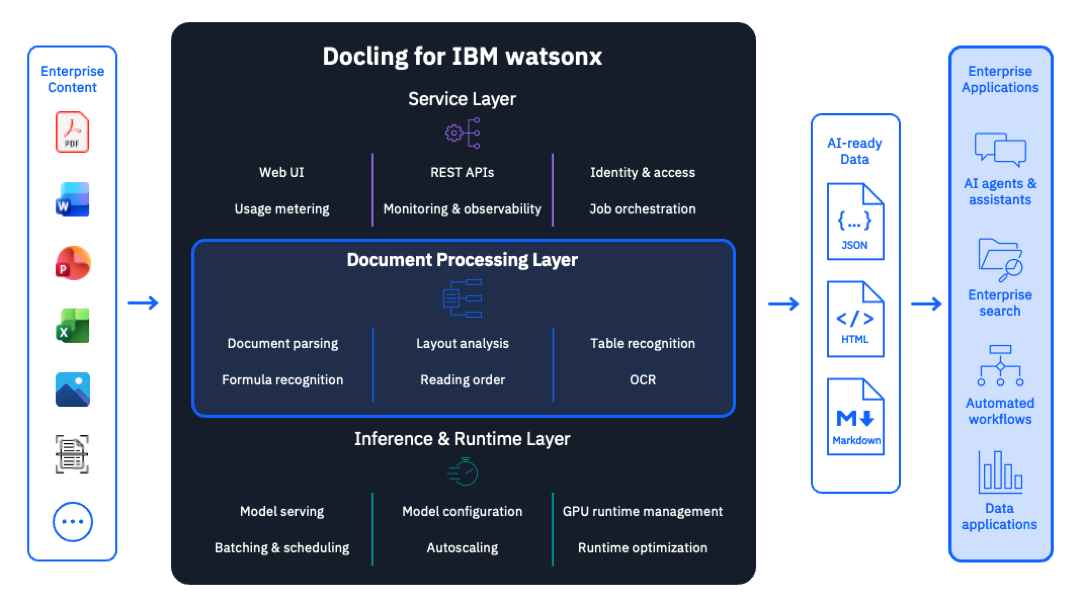
Docling for IBM watsonx is built as a three-layer managed architecture. Rather than exposing only document understanding capabilities, the service combines enterprise APIs, an optimized document processing layer, and a managed runtime into a single platform. Together, these layers deliver faster document processing, higher-quality AI-ready structured outputs, and eliminate the operational complexity of running document intelligence infrastructure. Every layer has a distinct responsibility, allowing developers to focus on building AI applications instead of managing document processing systems.
Service layer: APIs, web interface, and job orchestration
The Service layer is the interface between your applications and the document processing engine. It provides WebUI, REST APIs, authentication and authorization, usage metering, billing, and job orchestration.
Whether documents are submitted through the API or the web interface, every request enters the platform through this layer. Everything beneath this service layer (from processing infrastructure to runtime management) is fully abstracted.
Web interface
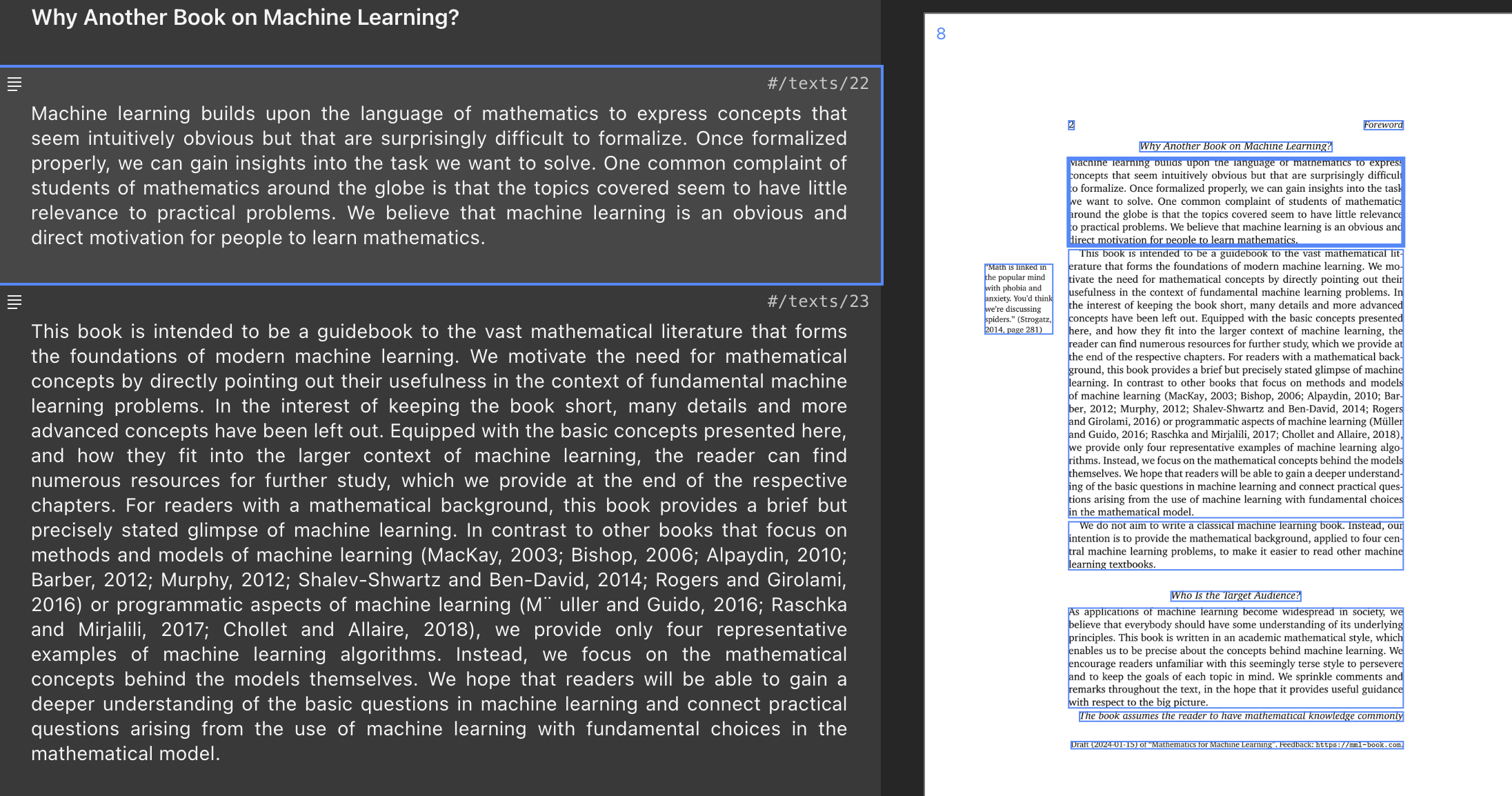
The web interface is ideal for experimenting with document conversion and validating results. You can view the output side-by-side with the original document, seeing exactly what was preserved, what was extracted, and how the structure maps to the source.
REST APIs
Production applications typically process thousands, or even millions, of documents. For these workloads, Docling for IBM watsonx exposes the same capabilities through a simple REST API and Python SDK. With the DoclingServiceClient, you can drive high-throughput document conversion directly from your application or pipeline:
```
from pathlib import Path
from docling.service_client import DoclingServiceClient

SERVICE_URL = "https://api.aws-c1.dcls.saas.ibm.com/20260626-0808-3309-1094-6a2039b201f5"
API_KEY = "your-api-key"

with DoclingServiceClient(url=SERVICE_URL, api_key=API_KEY) as client:
    result = client.convert(
        source=Path("path/to/your/file.pdf")
    )

print(result.document.export_to_markdown())
```
Optimized processing: document understanding at scale
The Optimized Processing layer is where document understanding happens. Built on the proven Docling OSS foundation, it performs document parsing, OCR (when required), visual layout analysis, table structure recognition, reading order reconstruction, and document assembly.
Under the hood, specialized AI models identify and retain table layouts, reading order, captions, and images as they appear in the original document. OCR is good at recognizing text, but not at understanding how that text is organized on a page. That's why Docling sidesteps OCR wherever possible and instead recognizes and categorizes visual elements directly, retaining the layout, hierarchy, and document relationships that plain text extraction would otherwise discard. When OCR is unavoidable, such as with scanned PDFs or image-based documents, Docling incorporates it into the pipeline without sacrificing structural context.
Docling for IBM watsonx builds on these core capabilities with newer document understanding models, improved batching and GPU utilization, distributed CPU/GPU processing, and parallel processing workers. These enhancements improve processing efficiency while preserving document fidelity, and they let the service continuously evolve as IBM Research and engineering deliver new innovations.
Developers also no longer need to choose or configure OCR or table extraction models themselves. Docling for IBM watsonx uses enhanced models that deliver improved accuracy for table recognition, layout analysis, and OCR, simplifying document processing while consistently producing high-quality AI-ready structured outputs.
The output is structured Markdown, Text, HTML, JSON, DocLang, and DCLX, with document hierarchy, table data, page references, metadata, chunks, and downstream document structure intact. This gives you clean input for RAG, search, extraction, and agent workflows.
Inference and runtime: IBM-managed GPU infrastructure
The Inference and Runtime layer manages the compute infrastructure that powers document processing. IBM manages the inference runtime, model configuration, batching and scheduling, GPU runtime management, autoscaling, and continuous runtime optimization. Users never need to provision GPUs, manage inference servers, configure scaling policies, or monitor processing infrastructure as those operational responsibilities are handled entirely by Docling for IBM watsonx.
Docling OSS versus Docling for watsonx
Teams who have used the open-source Docling toolkit will recognize the strengths it brings to document understanding. The question isn't whether Docling works; the question is which deployment model fits your team.
The managed service builds on the proven Docling OSS foundation with newer document understanding models, optimized runtime execution, and cloud-native infrastructure designed for production-scale document processing. These enhancements improve throughput, reduce latency, and continuously improve document understanding, without requiring developers to tune infrastructure or manage model lifecycles.
| Docling OSS | Docling for IBM watsonx | |
|---|---|---|
| Best for | Experimentation, local development, custom deployments | Production AI workloads at enterprise scale |
| Infrastructure | You manage GPUs, workers, queues, scaling | Fully managed by IBM |
| Model updates | Manual updates and redeployment | Continuous improvements delivered automatically |
| OCR & table model selection | Manual configuration | Automatic model selection for every document |
| Performance | Depends on hardware and deployment tuning | Optimized runtime with high throughput and low latency |
| Support | Community | IBM enterprise SLA |
| Cost | Compute cost | $4 per 1,000 pages (flat) |
Running Docling OSS in production means owning the infrastructure: GPUs, queues, workers, scaling policies, inference servers, monitoring, and operational reliability. Every improvement IBM Research ships to the underlying models requires you to pull, rebuild, and redeploy. Every traffic spike requires you to provision additional capacity and tune your deployment for consistent throughput.
Docling for IBM watsonx removes this operational burden. IBM manages the runtime, infrastructure, scaling, and lifecycle of the service, while continuously delivering improvements to document understanding models and runtime performance. Developers simply integrate the API and immediately benefit from higher throughput, improved document understanding, and enterprise-grade operational reliability without changing their applications.
Migrating from Docling OSS to Docling for IBM watsonx is straightforward and requires only minimal code changes. Replace the local DocumentConverter with DoclingServiceClient, configure your service endpoint, and your existing document workflows, downstream integrations, and output formats continue to work as before.
Docling OSS:
```
from docling.document_converter import DocumentConverter

source = "https://arxiv.org/pdf/2408.09869"
converter = DocumentConverter()
doc = converter.convert(source).document
print(doc.export_to_markdown())
```
Docling for IBM watsonx:
```
from pathlib import Path

from docling.service_client import DoclingServiceClient

SERVICE_URL = "https://api.aws-c1.dcls.saas.ibm.com/20260626-0808-3309-1094-6a2039b201f5"
API_KEY = "your-api-key"

with DoclingServiceClient(url=SERVICE_URL, api_key=API_KEY) as client:
    result = client.convert(
        source=Path("path/to/your/file.pdf")
    )

print(result.document.export_to_markdown())
```
Getting started with Docling for IBM watsonx
Docling for IBM watsonx is generally available as a fully managed SaaS offering hosted on AWS. Processing documents in under a second per page, achieving table reconstruction quality of up to 0.921 TEDS, and delivering up to 14× faster processing than a standard Docling OSS deployment, Docling for IBM watsonx is built to meet the scale, speed, and quality requirements of production AI workloads.
You can get started for free using the web interface, then seamlessly transition to API-based integration as you embed document intelligence into your applications and pipelines.
Start your 30-day free trial of Docling for IBM watsonx today. The Docling for IBM watsonx service is also available through the IBM Marketplace and AWS Marketplace with simple, predictable pay-as-you-go pricing of $4 per 1,000 pages. At scale, organizations can save $1,000 per million pages processed compared to the lowest-priced comparable managed offering. Annual subscription plans are also available starting at 1 million pages per year, including enterprise support and premium processing throughput.
You can give Docling for IBM watsonx (and IBM Bob) a try in this tutorial, "Extract structured data from messy documents with Docling for IBM watsonx and IBM Bob."
Whether you're building RAG pipelines, enterprise search, or AI agents, the quality of your AI depends on the quality of your document preparation. Docling for IBM watsonx provides the speed, document fidelity, and predictable economics needed to make AI-ready document processing a foundation, not a bottleneck, for enterprise AI.
Join us for our upcoming webinar, "Introducing Docling for IBM watsonx: documents to structured data for AI" on September 3, 2026 to learn more.