Meet the 2025 winners
Read more below on how the 2025 Global Challenge winners applied watsonx from IBM to address issues such as decent work and economic growth, clean water, and industry, innovation, and infrastructure challenges.
Grand Prize: DuniAfrika
Participant location: Kenya
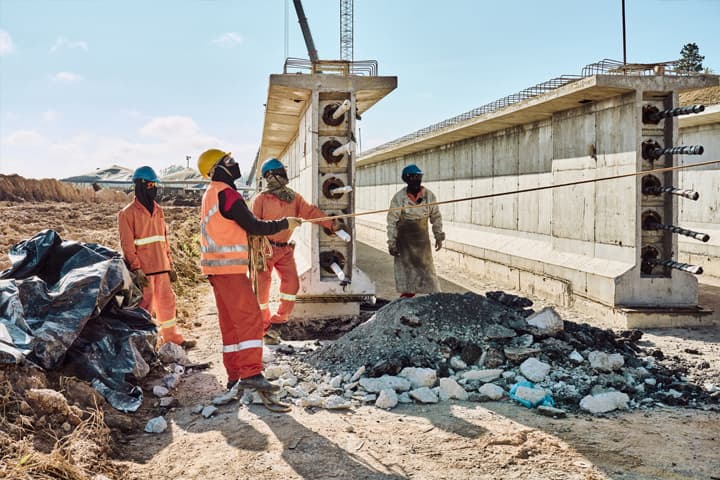
In Nairobi, over 60% of workers operate in the informal economy – from construction laborers and roadside welders to market vendors and small-scale artisans. These workers power the city`s growth but face daily risks from unsafe work conditions, including unregulated equipment, lack of protective gear, unstable structures, and hazardous materials. They also often lack access to formal safety training, regulatory oversight, or employer protections. Injuries and accidents not only harm individuals but also destabilize household incomes, reduce productivity, and strain public health systems – limiting sustainable economic growth.
Team DuniAfrika built a solution called Linda – an AI-powered safety assistant designed to protect informal sector workers by delivering real-time, personalized safety guidance integrated into a platform they already use daily for communications: WhatsApp. The worker can send a photo of their work environment to Linda on WhatsApp. Linda`s AI vision model analyzes the image to detect potential hazards, such as missing protective equipment, unstable structures, exposed wiring, or unsafe machinery. Linda replies instantly, highlighting risks and providing actionable, context-aware recommendations in conversational Swahili or English. Workers can also ask Linda safety-related questions (e.g., "Is it safe to use this ladder?"). Linda responds using a fine-tuned natural language model trained on localized safety protocols adapted for informal work environments. Over time, Linda proactively sends tailored reminders, motivational nudges, and safety tips based on each user`s role and typical risks. Linda offers personalized, interactive, real-time, context-aware coaching in the worker`s own language and communication style.
The solution integrates IBM Granite to power both natural language understanding and image analysis. It uses IBM Granite Vision to analyze and process images. The analysis is forwarded to Granite Instruct, which interprets the analysis and creates a viable, comprehensible response to the user in their own language or desired format. IBM Granite Instruct also generates responses to users text queries. These models continuously improve based on user interactions and feedback.
As the top-scoring university team, DuniAfrika is also the recipient of the university grant for their schools: University of Nairobi, Jomo Kenyatta University, Kirinyaga University.
Key tech used in their solution:

First runner-up: Young & Hungry
Participant location: India
Managing groundwater availability is critical everywhere, but especially in India where nearly 25% of global groundwater is used. Depletion of critical aquifers threatens states like Punjab, Rajasthan, and Andhra Pradesh, where groundwater levels have plummeted below sustainable thresholds. This crisis endangers food security, rural livelihoods, and water sustainability for the whole nation.
The “Wise Drop” solution uses agentic AI to provide user-specific experiences, empowering everyone involved in managing groundwater with data and insights specific to their role. Farmers can interface simply through local-language Whatsapp and get personalized irrigation advice and crop recommendations to help them reduce water usage and improve yields. Local water managers can monitor aquifer health and contamination risks, and get reports with prioritized actions, allowing them to optimize resources more effectively. Policy-makers can run simulations on the impacts of different intervention methods and generate data-driven policy recommendations that consider agricultural productivity and aquifer preservation.
The solution leverages IBM watsonx.ai and Granite series models (Granite-3-2-8b-instruct, Granite-guardian-3-8b, Granite-13b-instruct-v2, Granite-20B-multilingual) within a multi-agent workflow that integrates historical data, real-time weather inputs, and contamination reports. Each specialized agent uses a specific Granite model best suited for its function.
Key tech used in their solution:

Second runner-up: Agents FDRK
Participant location: India
In moments of urban crisis such as infrastructure failures, flooding, fires, or road accidents, delays in coordinating the appropriate response can be critical. In rapidly growing urban areas like Bangalore, a few lost minutes can cost lives and property. Current public emergency systems rely heavily on manual reporting, which makes it challenging to assess, prioritize, and route help to incidents in real time.
The “Alert X” solution from team Agents FDRK seeks to make cities safer, more connected, and resilient. It helps reduces the gap between incident detection and emergency action from minutes to seconds. It’s is an autonomous, multi-agent AI framework that detects, analyzes, and communicates critical incidents to authorities with intelligent coordination. Built on IBM watsonx.ai and IBM watsonx Orchestrate, Alert X integrates visual understanding, contextual reasoning, and natural interaction into one continuous workflow. One agent captures live video frames from a mobile camera and uses Granite Vision or Llama-based visual models to identify the scene (e.g., flooded streets, fire, damaged infrastructure). It then produces a natural-language summary with detected risks and objects. Another agent uses Openstreet Map APIs to retrieve information on nearby critical facilities such as hospitals, schools, crowded spots, connectivity hubs, police stations, fire stations, and shelters. A third agent uses Granite 3.3 Reasoning LLM to analyze both the visual and the geographical data. It evaluates severity, impact, and urgency, then recommends actionable steps such as “Evacuate nearby area,” “Ensure no children in the surrounding schools go outside,” “Notify fire department,” or “Divert vehicles to alternate route.” Finally, after user approval, a fourth agent generates a human-like conversational script to brief authorities. It mimics a real person’s tone providing event context, urgency, and help needed, ensuring clear, empathetic communication.
Watsonx Orchestrate runtime triggers each agent, monitors outputs, and maintains the contextual flow. The team hopes to implement more agents in the future such as a drone data assessor or citizen chatbot.
Key tech used in their solution:


