Article
APIs vs. messaging: When to use APIs, when to use messaging, or when to use both
Decide when to use each or a combination of both for robust application architectureAPIs and messaging are two fundamental approaches to connecting applications, and choosing between them depends on your communication requirements. APIs work best for synchronous, direct interactions; messaging excels at decoupling services and ensuring reliable delivery. In many real-world solutions, you'll use both.
APIs (application programming interfaces) have existed since the beginning of computers. As the web became ubiquitous, the term "API" came to refer to HTTP REST-based services. REST (representational state transfer) provides access to resources using standard HTTP operations such as GET, PUT, POST, or DELETE. For example, a system can request information regarding a book by sending the following request:
GET http://mybookstore/books/mybook
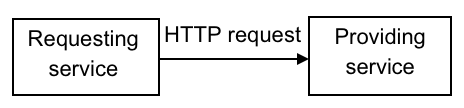
In this example the GET operation is used to declare that we are attempting to read the current state. The URL http://mybookstore/books/mybook is then used to identify the resource to be retrieved. The following figure shows a basic REST API.
Messaging encourages a decoupled architecture, where an intermediary — often referred to as a messaging provider — is placed between two applications, systems, or services. The messaging provider facilitates communication between the sender and receiver of messages and provides many benefits such as reliable delivery, work load balancing, and security.
Some examples of messaging providers include:
- IBM MQ
- RabbitMQ
- ActiveMQ
- Apache Kafka
A messaging client is used to communicate with a messaging provider. A client can take the role of either or both of these:
- Requesting service or producer
- Providing service or consumer
Requesting services publish (PUT in REST terminology) a message to request processing, while the providing service subscribes (GET in REST terminology) to the message to complete the processing.

Characteristics of APIs and messaging
APIs and messaging are widely used technologies, both individually and together. The key to success is understanding their characteristics so that you can select the right option based on the communication requirements:
| Characteristic | APIs | Messaging |
|---|---|---|
| Interaction styles | HTTP is synchronous. Each request message has a corresponding response; that is, an acknowledgement of the request message. This makes request/response solutions easy to implement. | Messaging is asynchronous, and allows a full range of interaction patterns, including: fire and forget, where requesting messages do not have corresponding responses; request/response, where each request message has a corresponding response; and publish/subscribe, where applications, systems, or services can register for messages on a defined topic. The messages are forwarded to all subscribers when publishers emit events. |
| Application usage | Ubiquitous. Almost all companies have IT infrastructures that support HTTP traffic, and most programming languages provide built-in support for HTTP. | Simplified application development. Messaging frees you from coding complex delivery mechanisms to assure messages are not lost, freeing you to focus on business logic. |
| Coupled | Simple. Communication flows directly from the requester to the providing service (unless the architecture deliberately introduces intermediaries that control the communication). | Decoupled. The messaging provider acts as a shock absorber between applications, protecting the messages. If the server or receiving application goes down, or it is too busy to process more requests, the message can wait in the messaging provider until the systems are up and it can be delivered. |
Deciding which architecture is right for your application
To help you decide whether to use APIs or messaging, let's consider three different scenarios.
In the first scenario, a retailer exposes their product catalog. By exposing their product catalog, a partner can quickly and easily access it on their own. The data in the catalog is read-only, so users can repeat requests in error situations. The simple and synchronous characteristics of RESTful APIs make this a natural choice.
In the second scenario, a healthcare provider updates a patient's record after they treat the patient. The health data represents a mission-critical communication to both the healthcare provider and the patient. The assure messages are not lost characteristic of messaging is valuable here.
In the final scenario, let's consider a retailer's digital transformation. The retailers can build new engaging applications which can allow partners to sell their products. Access to the catalog and ordering systems is required. In this situation, a combination of APIs and messaging is logical. Where simple and synchronous is important, the catalog is exposed, using APIs, and messaging provides access to the order system to assure that messages are not lost and decoupling to handle peak workloads.
Summary
Deciding between APIs and messaging is not an either/or decision. Both offer distinct advantages: APIs for simplicity and synchronous interactions, and messaging for reliability and decoupling. Most robust applications benefit from combining both approaches.
To go deeper, explore the difference between events and messages or learn how messaging simplifies microservice applications.